
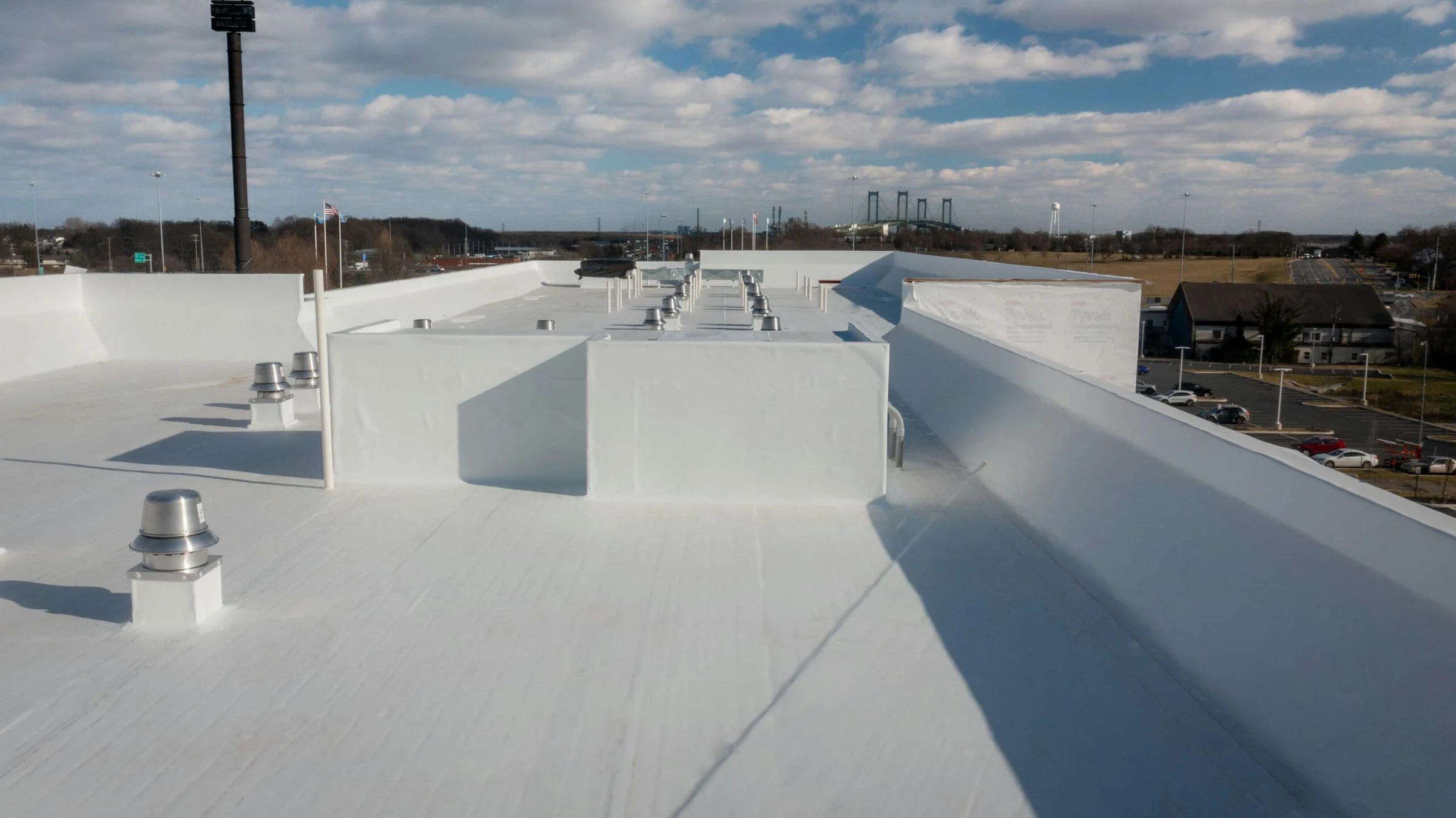
TPO 80-Mil Roofing in Fayetteville, NC
80-mil TPO for warehouses, government, and institutional roofs around Fayetteville and Fort Liberty. Durability, wind uplift, and long-hold lifecycle cost.
TPO 80-Mil Roofing in Fayetteville, NC
80-mil TPO for warehouses, government, and institutional roofs around Fayetteville and Fort Liberty. Durability, wind uplift, and long-hold lifecycle cost.
When a Fayetteville Roof Calls for 80-Mil Instead of 60
We move a building up to 80-mil TPO when the roof will carry more than average abuse over its life - dense rooftop equipment, government occupants who hold a building for decades, or a warehouse where techs are up top constantly. The extra 20 mils isn't about looking better on a spec sheet. It buys margin against the things that actually shorten a roof's life.
What the Extra Mass Buys You
Thicker membrane resists puncture and abrasion longer, which matters most on roofs with real foot traffic - not the occasional service call, but daily or weekly trips to rooftop units, satellite equipment, or generator pads. County and municipal buildings around Cumberland County often fall into this category simply because of how much mechanical and communications equipment ends up mounted on the roof over the years.
Reinforcement scrim sits deeper in an 80-mil sheet relative to the surface, so a scuff or minor gouge from a dropped tool is less likely to expose it. That's a meaningful difference on a roof that's going to see twenty-plus years of technicians walking it, not five.
Rooftop Equipment Density and Curb Detailing
Warehouse and distribution roofs, plus larger government and institutional buildings, tend to carry a lot more penetrations per square foot than a standalone retail box - HVAC curbs, exhaust fans, skylights, conduit runs, sometimes fall-protection anchors. Every one of those is a place where the membrane gets cut, flashed, and stressed. Thicker membrane gives the flashing details more material to work with at these transitions, particularly at older curbs that have settled or shifted slightly out of square over the years.
We flag curb condition during the pre-bid walk on every 80-mil job, because reflashing a rotted or undersized curb costs far less mid-project than discovering it after the membrane's already welded around it.
Wind Uplift on Larger Roof Footprints
Bigger buildings mean more linear feet of perimeter and more corners - and corners and perimeter are exactly where wind uplift forces concentrate hardest during a remnant tropical system moving through the Sandhills. On a large warehouse or distribution building, tightening the field fastening pattern alone isn't enough; we recalculate enhanced zones based on actual building height, parapet detail, and exposure category for that specific footprint, rather than applying a one-size perimeter width across a building that might run several hundred feet on a side.
Eighty-mil membrane doesn't fix a bad fastening pattern by itself, but it gives the field more resistance to propagating a tear if wind does get under an edge somewhere the pattern was marginal to begin with.
The Long-Hold Math Behind the Membrane Choice
A lot of owners in this market - school districts, county government, hospital systems - aren't planning to sell the building in five years. They're budgeting for a thirty-year hold. Under that math, paying more per square foot up front for 80-mil against fewer recover cycles and less mid-life membrane replacement usually wins out over the cheapest bid on day one. We run the lifecycle comparison with actual numbers rather than assuming heavier automatically pencils out - sometimes 60-mil with a stronger fastening spec is still the better call for a specific building.
Signs a Roof Should Move Up to 80-Mil
- More than a handful of rooftop units, exhaust fans, or curbs per 10,000 square feet
- Regular technician or contractor foot traffic beyond routine maintenance visits
- Ownership plans to hold the building 20 years or longer
- History of membrane punctures or tears from equipment servicing
- Exposure category that puts the building in a higher wind design pressure
- Roof also supports fall-protection systems or permanent ladders and platforms
Keeping Loading Docks Open During the Tear-Off
On distribution and warehouse buildings, the roof crew works around dock schedules, not the other way around. We stage tear-off sections so dock doors below stay clear of falling debris and material drops, and we coordinate crane placement so trailers can still back in and pull out on their normal cycle. A warehouse operator loses more money from a blocked dock door for an afternoon than from paying us to plan around it.
For buildings running multiple shifts, we can shift noisy demolition work to hours that don't overlap with the busiest dock windows, keeping the disruption to loading operations close to zero across the job.
Frequently Asked About 80-Mil TPO
Is 80-mil TPO worth it on a small retail building?
Usually not. A single-tenant retail box with light equipment and low traffic gets full value from 60-mil TPO at a lower cost. We reserve 80-mil for roofs with the traffic or hold-period profile that actually needs it.
Does 80-mil TPO cost significantly more than 60-mil?
Material cost runs higher per square foot, but labor and detailing costs are close to identical. On a large roof the percentage difference is usually smaller than owners expect once total project cost is compared.
Can 80-mil TPO be mechanically fastened or does it need to be adhered?
Either works, and the choice depends on deck type, insulation, and wind zone rather than membrane thickness. We size the attachment method to the building, then confirm the membrane thickness fits the traffic and hold-period profile separately.
How long should an 80-mil TPO roof last with normal maintenance?
Service life depends heavily on maintenance follow-through - keeping drains clear of pine debris, addressing minor punctures quickly, and not deferring flashing repairs. Manufacturers publish warranty terms that vary by system and attachment method, which we review against the specific building at proposal stage.
Does 80-mil TPO handle hail better than 60-mil?
Thicker membrane generally resists hail bruising and puncture better, which is relevant here given the severe thunderstorm activity that moves through the Sandhills in spring and summer, separate from tropical remnant events.