
Black EPDM Roofing in Fayetteville, NC
Black EPDM membrane for Fayetteville schools, government, and institutional roofs. Seam tape quality, ballast vs adhered attachment, and heat considerations.
Black EPDM Roofing in Fayetteville, NC
Black EPDM membrane for Fayetteville schools, government, and institutional roofs. Seam tape quality, ballast vs adhered attachment, and heat considerations.
Black EPDM's Place on Cumberland County's Institutional Roofs
Black EPDM has been on commercial roofs longer than any other single-ply membrane, and it's still the right call on a good number of the school, government, and institutional buildings we work on around Fayetteville. It isn't the default choice it was thirty years ago, but the rubber's elasticity and long field history still make it worth specifying on the right building.
Why a Rubber Membrane Still Earns the Spec
EPDM is a synthetic rubber sheet, and rubber's defining trait is elasticity - it stretches and recovers rather than cracking under stress the way a more rigid material might. That matters on buildings with a lot of deck movement, older structures with some settling, or roofs that see hail impact regularly. A membrane that flexes around an impact rather than fracturing tends to hold up better over a long ownership horizon, which describes a lot of the county and school district buildings we bid on.
It's also a membrane with decades of installed roofs to point to. When a facilities director asks how a system performs at year twenty, EPDM has more real answers than newer chemistries do.
Being Honest About Black Membrane in a Hot, Humid Climate
Black EPDM absorbs more solar heat than a white membrane, and Fayetteville's Sandhills summers run hot and humid well into September - so we don't pretend that's a non-issue. On buildings where rooftop cooling load matters, we talk owners through the tradeoff directly: a white TPO or a white-coated EPDM keeps the deck cooler, while black EPDM's durability and cost profile can still win out on a building where energy load isn't the deciding factor, particularly under a ballasted system where stone cover moderates surface temperature anyway.
It's a real tradeoff, not a reason to rule EPDM out automatically. The right answer depends on the building's HVAC situation and how the owner weighs upfront cost against long-term cooling costs.
Seam Tape: The Detail That Decides How Long the Roof Lasts
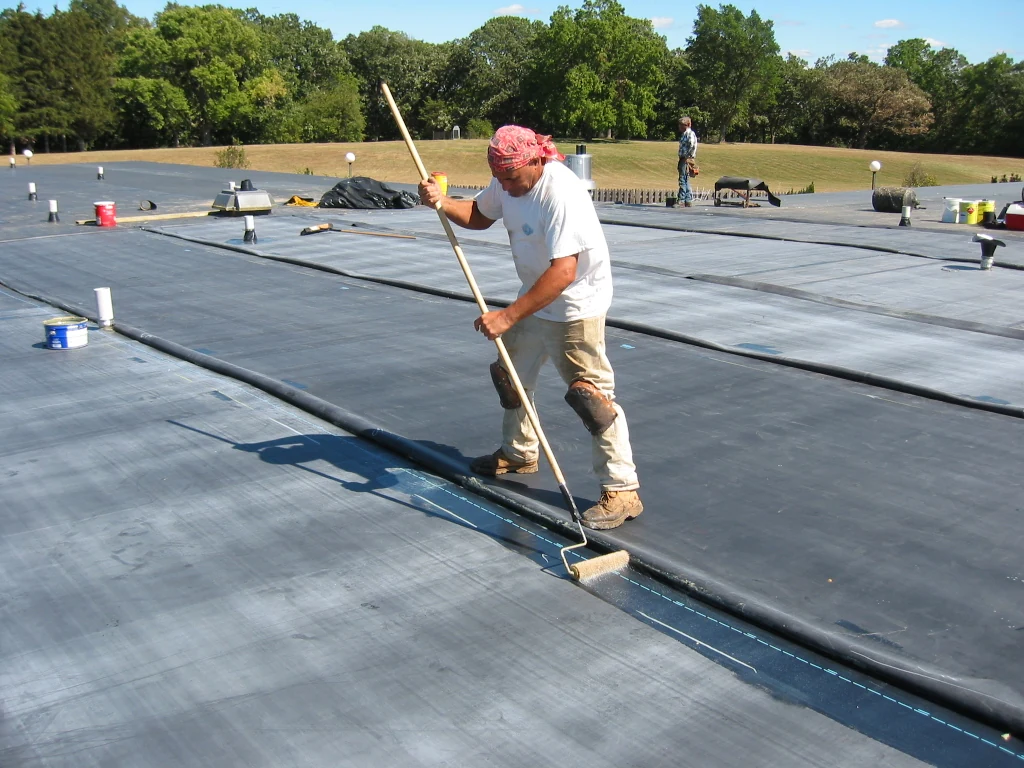
Unlike welded TPO or PVC, EPDM seams are historically bonded with adhesive tape rather than heat-fused into one sheet. That makes seam prep and tape application the single most important part of an EPDM install - a rushed or dirty seam is where these roofs fail first, almost always years before the field membrane itself gives out.
We treat seam work as its own discipline on every EPDM job: proper primer application, correct roller pressure, and enough cure time before the seam sees foot traffic or weather. Newer tape formulations have closed a lot of the gap with welded systems, but only when installed correctly.
Ballasted, Mechanically Attached, or Fully Adhered
EPDM comes in three basic attachment methods, and the right one depends on the building more than owner preference. Ballasted systems - membrane held down by stone or pavers rather than fasteners or adhesive - work well on structurally sound roofs with simple geometry, and the stone layer adds UV protection and impact cushioning. Mechanically fastened systems suit buildings where added dead load isn't practical. Fully adhered systems give the cleanest, lowest-profile finish and handle complex roof shapes with a lot of penetrations better than loose-laid ballast.
Ballast and Wind: What Changes Near Hurricane-Remnant Season
Ballasted EPDM raises a specific concern in this region that doesn't come up as often inland: loose stone becomes airborne debris in sustained high wind, and remnant tropical systems moving through the Sandhills bring exactly that kind of sustained wind even without a direct hurricane strike. On buildings exposed to open terrain or sited near parking lots and pedestrian areas, we often steer owners toward fully adhered or mechanically fastened EPDM instead of ballast, specifically to avoid ballast scatter during a wind event.
- Roofs with existing structural capacity for ballast dead load and simple field geometry
- Buildings prioritizing long-term membrane elasticity over reflectivity
- School and government facilities with multi-decade ownership horizons
- Roofs sheltered from open wind exposure where ballast scatter risk is low
- Projects where cured EPDM's field-proven seam repair methods simplify future maintenance
Reroofing a School or Government Building Without Disrupting It
School reroofs get scheduled around the academic calendar wherever possible, and when they can't wait for summer break, we sequence demolition and noisy work outside class hours and keep HVAC service to occupied wings uninterrupted. Government buildings get the same treatment - work sequenced so records offices, courtrooms, or public-facing counters stay open and conditioned throughout the project rather than closing a wing to get the roof done faster.
That phasing takes longer than tearing off the whole roof at once, but it's the difference between a project that finishes cleanly and one that generates complaints from every department head in the building.
Questions on Black EPDM
Does black EPDM void any energy code requirements in North Carolina?
Reflectivity requirements vary by jurisdiction and building type, and some projects need a reflective cap sheet or coating over EPDM to meet code. We check the applicable requirement for the specific building before finalizing the membrane color and attachment method.
How does EPDM compare to TPO for puncture resistance?
EPDM's elasticity lets it flex around a lot of impacts that might puncture a stiffer membrane, though a sharp, concentrated impact can still cut it. Heavier TPO resists puncture through raw thickness instead, which is a different mechanism reaching a similar result.
Can an old taped seam be repaired without replacing the whole roof?
In most cases, yes. Seam repair is one of EPDM's most straightforward maintenance tasks when caught early, which is part of why regular roof inspection pays for itself on these systems.
Is ballasted EPDM ever appropriate here given the wind concern?
On sheltered, low-exposure sites with strong structural capacity, yes. We evaluate exposure category and site conditions building by building rather than ruling ballast out across the board.
How long has EPDM been used on commercial roofs?
It's one of the oldest single-ply membrane technologies still in wide use, with installed roofs going back decades, which is why facilities managers with older buildings often already have some familiarity with how it ages.