
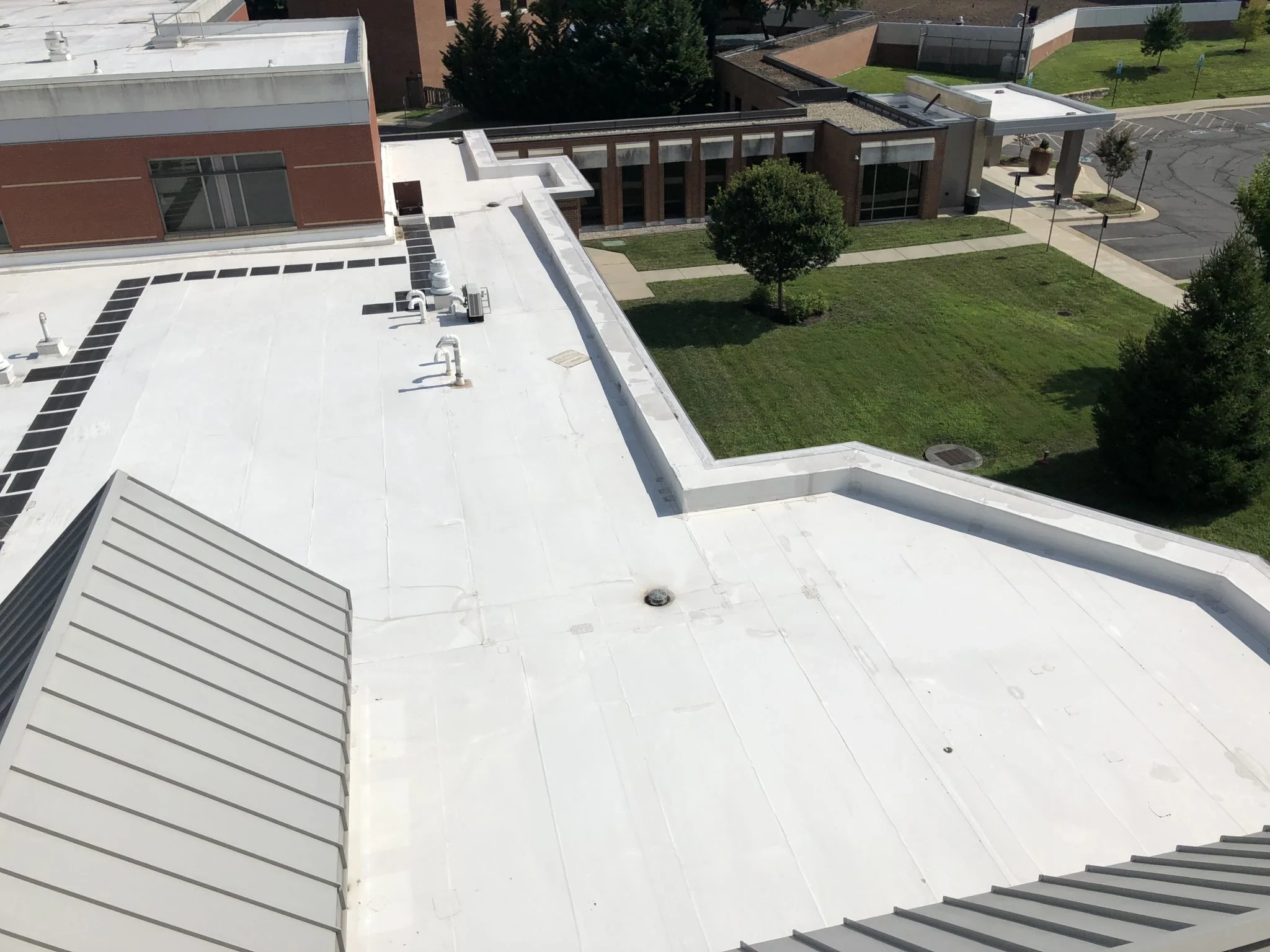
White EPDM Roofing in Fayetteville, NC
White-surfaced EPDM for Fayetteville hospitals, hotels, and retail roofs needing rubber's flexibility plus reflectivity. Fleece-backed options and detailing.
White EPDM Roofing in Fayetteville, NC
White-surfaced EPDM for Fayetteville hospitals, hotels, and retail roofs needing rubber's flexibility plus reflectivity. Fleece-backed options and detailing.
Reflective EPDM for Buildings That Need Both Elasticity and Cooler Roof Surfaces
White-surfaced EPDM gives an owner most of standard black EPDM's flexibility and impact tolerance with a reflective top layer that keeps the roof surface and rooftop equipment noticeably cooler through a Sandhills summer. We spec it on hospitals, hotels, and retail buildings around Fayetteville where cutting rooftop heat gain matters as much as membrane durability.
What Changes With a Reflective Surface
The rubber compound underneath is fundamentally the same material as standard EPDM - same elasticity, same tear resistance, same decades-proven chemistry. The difference is a white surface layer, sometimes laminated to the sheet during manufacturing and sometimes applied as a factory coating, that reflects solar radiation instead of absorbing it. That surface treatment doesn't change how the membrane handles building movement or hail impact; it changes how hot the roof gets on a July afternoon.
For a building near Cape Fear Valley or a hotel along the I-95 corridor running rooftop package units nearly year-round, a cooler roof surface translates directly into less strain on that equipment and lower cooling costs for the floors underneath.
Fleece-Backed Construction and Fully Adhered Installs
A lot of white EPDM we install comes fleece-backed - a polyester fleece laminated to the underside of the membrane that bonds to adhesive far more consistently than bare rubber does. Fleece-backed sheets are almost always installed fully adhered, which gives a clean, low-profile finish that handles roofs with heavy penetration counts - multiple curbs, drains, pipe boots - better than a mechanically fastened or ballasted system would.
Fully adhered also means no exposed fasteners for wind to work against and no loose ballast to worry about, which simplifies the wind design conversation considerably compared to a ballasted black EPDM roof.
Where It Sits Between Black EPDM and TPO
Owners sometimes ask why we don't simply install white TPO instead. The honest answer is that white EPDM's rubber base still flexes more than TPO's more rigid thermoplastic sheet, which some facilities managers value on buildings with known deck movement or a history of membrane cracking at penetrations. TPO's welded seams are generally easier to quality-check in the field than adhered EPDM seams, so the tradeoff runs the other direction on seam workmanship risk. Neither system is categorically better - it depends on what the specific roof has struggled with historically.
Cooling Load on Occupied Buildings
Hospitals and surgery centers run continuous rooftop mechanical loads that don't get a break overnight the way an office building's might. A cooler roof surface reduces the heat that rooftop condensing units have to fight against, which shows up as real HVAC runtime savings on a building that never stops needing conditioned air. Hotels see a similar pattern, especially in guest wings directly under the roof deck where surface temperature bleeds through into upper-floor comfort.
- Hospitals and outpatient surgery centers with continuous mechanical loads
- Hotels along Bragg Boulevard and the interstate corridor with top-floor guest rooms
- Retail buildings with rooftop package units running long daily cycles
- Buildings with a documented history of membrane cracking under a dark surface
- Projects targeting a lower roof surface temperature for energy code compliance
Wind Considerations for Fully Adhered White EPDM
Because fully adhered systems don't rely on ballast weight or exposed mechanical fasteners, the wind uplift conversation centers on adhesive bond strength and perimeter/corner enhancement rather than ballast scatter risk. That's a real advantage on sites exposed to open wind near parking lots or on taller buildings where remnant tropical system winds hit hardest at the roof edge. We still calculate enhanced fastening and adhesive coverage zones off the building's actual exposure category rather than a generic spec.
Keeping Patient Floors and Guest Wings Dry During the Work
Hospital reroofs get sequenced section by section with temporary protection over any open area at the end of every shift - there's no scenario where a patient floor takes on water because a crew ran out of daylight. Hotels get similar treatment, with work zones planned around which guest rooms are occupied that week so housekeeping and front desk aren't managing complaints about noise or dust over booked rooms.
On both building types we coordinate closely with facilities staff on daily start times, because a crew starting demolition at 6 a.m. over a guest wing or a recovery unit creates problems no roof warranty covers.
Common Questions on White EPDM
Is white EPDM more expensive than standard black EPDM?
Yes, typically, because of the added surface treatment and the fact that most white EPDM is fleece-backed. The added cost is usually justified by cooling load savings on buildings running continuous rooftop equipment.
Does white EPDM stay clean, or does it discolor over time?
Some surface soiling and graying is normal over years of exposure, particularly near tree lines where pine debris and pollen settle on the membrane. It doesn't affect performance, though periodic cleaning helps maintain reflectivity.
Can white EPDM be installed over an existing roof?
Sometimes, depending on the condition of the existing deck and insulation. We evaluate that the same way we would for any recover project, with core cuts to confirm dry insulation before recommending it.
How does fleece-backed EPDM handle pine debris and drainage?
The membrane itself isn't affected by pine straw or needles sitting on the surface, but debris still needs to be cleared from drains and scuppers regularly or ponding will form regardless of membrane type.
Is a white membrane necessary for every hospital roof?
Not automatically - it depends on the building's mechanical load, insulation condition, and whether the owner is prioritizing energy performance. Some hospital buildings still make more sense with a different system entirely, which is why we walk each roof rather than defaulting to one answer.