
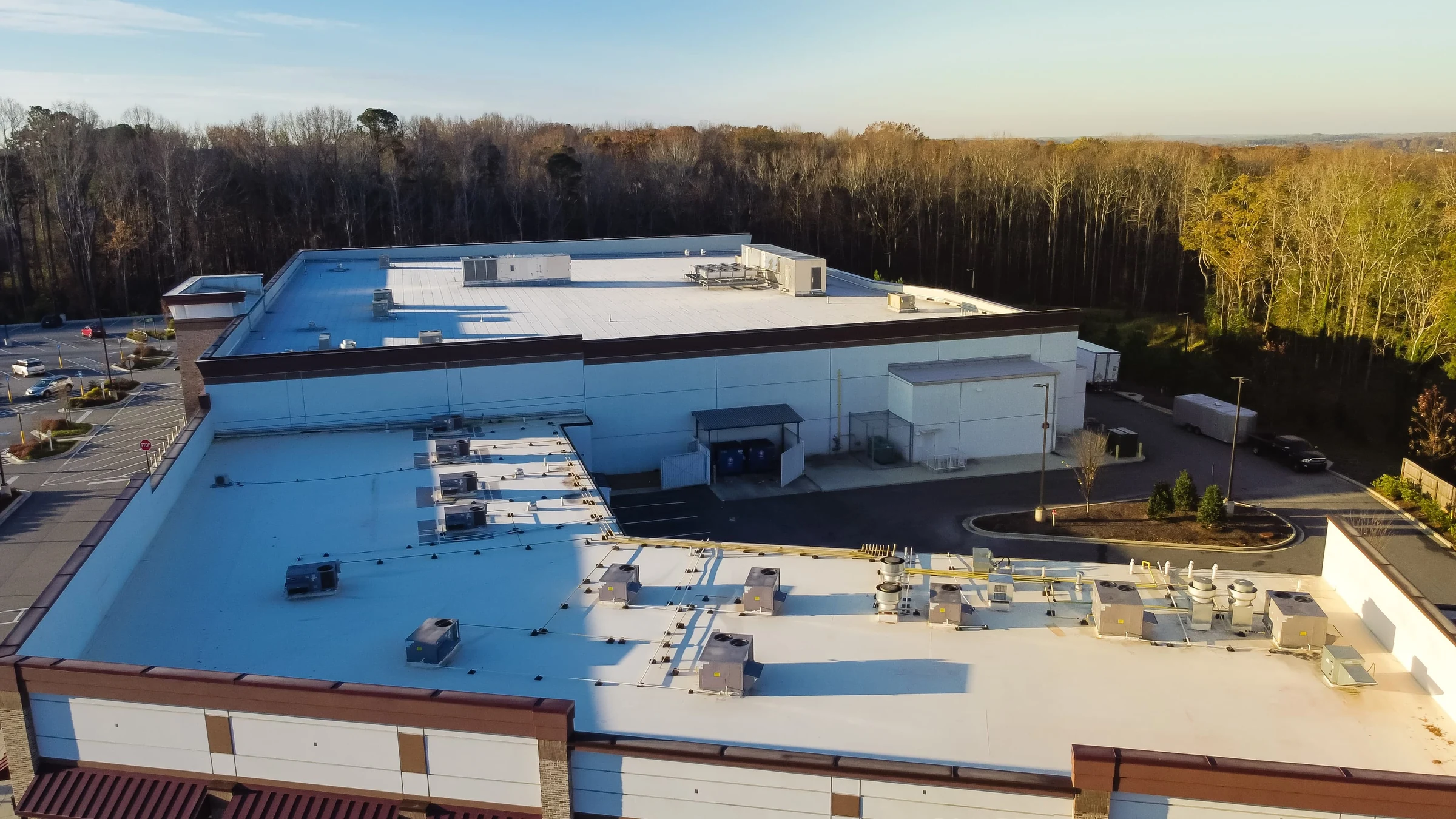
Grocery Store Roofing in Fayetteville, NC
Grocery store roofing in Fayetteville, NC: rooftop refrigeration protection, dock scheduling, and moisture control for supermarkets and grocery-anchored centers.
Grocery Store Roofing in Fayetteville, NC
Grocery store roofing in Fayetteville, NC: rooftop refrigeration protection, dock scheduling, and moisture control for supermarkets and grocery-anchored centers.
Roof Systems Built for Refrigeration and Backroom Loads
Grocery stores carry a different rooftop load than most retail: condenser units for refrigerated cases, walk-in coolers, and freezers, all running around the clock regardless of what the roof below them is doing. A leak near a condenser line or a freezer curb is a food-safety problem, not simply a ceiling stain, and every grocery roof project has to account for that difference.
Condenser Units and Refrigeration Lines on the Roof Deck
Grocers across this market run rooftop condensing units tied to in-store refrigeration, and those units come with refrigerant lines, condensate drains, and curbs that need careful flashing. We treat every one of those penetrations as a priority detail rather than an afterthought, because a failure there affects product on the shelves below, not simply the roof deck.
We also coordinate timing with whoever manages refrigeration maintenance for the store, since taking a condenser offline even briefly during a Cumberland County summer can put frozen and refrigerated inventory at risk.
Multiple Daily Deliveries and Dock Staging
A grocery store's loading dock sees far more truck traffic in a day than most retail formats, with produce, dairy, and dry goods arriving on separate schedules. We stage our own material deliveries and dumpster placement around that traffic instead of parking a roll-off where the produce truck needs to back in at six in the morning.
We confirm the store's actual delivery windows with the receiving manager rather than assuming a generic schedule, since produce and dairy trucks often run earlier than a store's posted operating hours would suggest.
Moisture Management in a Humid Climate
Cumberland County's humid summers and heavy seasonal rain make moisture intrusion a faster-moving problem on a grocery roof than in a drier climate, especially with cold surfaces from refrigeration equipment creating condensation points on the underside of the deck. We inspect insulation for trapped moisture as part of any grocery roof evaluation, not only the surface membrane, because wet insulation under a store full of food inventory is a bigger liability than a bit of surface wear.
Once insulation traps moisture, it stops performing the way it was designed to and starts adding weight to the roof assembly, so we treat any wet insulation finding as a repair priority rather than something to monitor and revisit later.
- Full-service supermarket chains
- Regional and independent grocery stores
- Grocery-anchored strip center end-caps
- Specialty and discount grocery formats
- Convenience stores with expanded grocery sections
- Grocery distribution and cold-storage annexes
Scheduling Around a Store That Never Fully Closes
Most grocery stores in this market run long hours seven days a week, which means there's rarely a quiet stretch to work with. We plan tear-off and membrane work section by section, keeping the sales floor dry and the HVAC and refrigeration systems running throughout, so the store never has to shut its doors or empty its cases to get a new roof.
Night and early-morning work windows come up often here, timed around restocking schedules rather than fighting them.
Hail and Wind Exposure on Wide Flat Spans
Grocery stores tend to sit on wide, low-slope roofs similar to big-box formats, which means the same wind-uplift and ponding concerns apply, layered on top of the refrigeration equipment load. After the region catches wind and rain from a weakening tropical system, we recommend checking drains and rooftop unit curbs specifically, since standing water around a condenser pad is one of the first places a slow leak starts.
Hail is a less frequent visitor here than in some parts of the country, but when it does hit, dented rooftop condenser fins and cracked skylight domes are worth checking alongside the membrane itself, since hail damage to equipment doesn't always show up as a roof leak right away.
Working With Corporate Facilities Teams Across Multiple Stores
Regional and national grocery chains typically manage roof maintenance through a corporate or regional facilities office rather than a single store manager, with standardized inspection schedules and preferred material specs applied across dozens of locations. We work inside those standards rather than proposing our own defaults, since a corporate team usually has fleet-wide reasons behind whatever spec they've settled on.
We still flag store-specific conditions back to that team when they matter, since a standard spec written for the whole chain doesn't always account for one store's particular drainage layout or unusually dense refrigeration equipment load compared to its sister locations.
The backroom and receiving area of a grocery store often sits under a lower roof section or canopy separate from the main sales floor roof, and that section takes different wear from constant dock door traffic, forklift exhaust, and cardboard bale storage below. We evaluate that section on its own terms rather than assuming it matches the condition of the main roof plane, since backroom roofs in this market often show wear patterns the sales floor roof doesn't have yet.
Bale compactors and cardboard storage in particular tend to generate more rooftop dust and debris buildup near backroom drains than the sales floor side, and clogged drains in that zone are a common source of a leak that shows up somewhere else entirely once water backs up and finds a low spot in the deck.
Questions Grocery Managers Ask Us
Can refrigeration stay running during roof work?
In almost every case, yes. We section work around active condenser units and coordinate directly with refrigeration technicians on timing.
Do you work overnight to avoid disrupting shoppers?
We can, and often do, especially for noisier tear-off phases, timed around the store's own delivery and restocking schedule.
How do you check for hidden moisture in insulation?
We evaluate wet or degraded insulation as part of the inspection, not only the surface membrane, since trapped moisture under refrigeration loads is common.
What roof systems hold up best around rooftop refrigeration equipment?
We commonly use TPO membrane systems detailed carefully around curbs and lines, though the right choice depends on the existing deck and equipment layout.
Do you coordinate with our refrigeration contractor directly?
Yes, we schedule around their maintenance windows so refrigerant lines and condensate drains aren't disturbed without their sign-off.