
Insurance Documentation Support in Fayetteville, NC
Roof damage documentation for Fayetteville, NC commercial property owners working through insurance claims — photos, moisture data, and dated condition records.
Insurance Documentation Support in Fayetteville, NC
Roof damage documentation for Fayetteville, NC commercial property owners working through insurance claims — photos, moisture data, and dated condition records.
Documenting the Roof, Not Negotiating the Claim
When Hurricane Matthew and later Hurricane Florence pushed record rainfall through this region, plenty of building owners found out how much a claim depends on what got documented and when. We build the roof-condition record; what happens with an insurer from there is the owner's process to run.
What We Actually Provide, and What We Don't
We document roof condition — photos tied to specific locations, moisture scan data, dated inspection notes — clearly enough that an adjuster or a public adjuster working on the owner's behalf has real information instead of a vague description. We do not represent the claim, negotiate settlement value, or promise a particular outcome, because that is not a roofing contractor's role and anyone who tells a building owner otherwise is overselling what they can actually deliver.
What we can say is that a well-documented roof, with a clear before-and-after record where one exists, gives an owner's claim a much stronger factual foundation than a single post-storm photo and a verbal description.
We also keep copies of every report and photo set we produce, which has mattered more than once when a claim gets reopened or reviewed months after the original storm, well after memory of exact conditions has faded for everyone involved.
Why Matthew and Florence Still Shape How Owners Think About This
Both storms hit this region as inland rain events more than wind events, and the roofs that fared worst afterward tended to be the ones nobody had a recent condition record for going in. An owner who could show an inspection report from six months before the storm had a much clearer picture of what changed than one working from memory about what the roof looked like beforehand.
That is the biggest reason we push standing inspection and maintenance programs even outside of active storm season — the value of a pre-storm baseline only shows up after the fact, and by then it is too late to create one retroactively.
What Gets Documented After Storm Damage
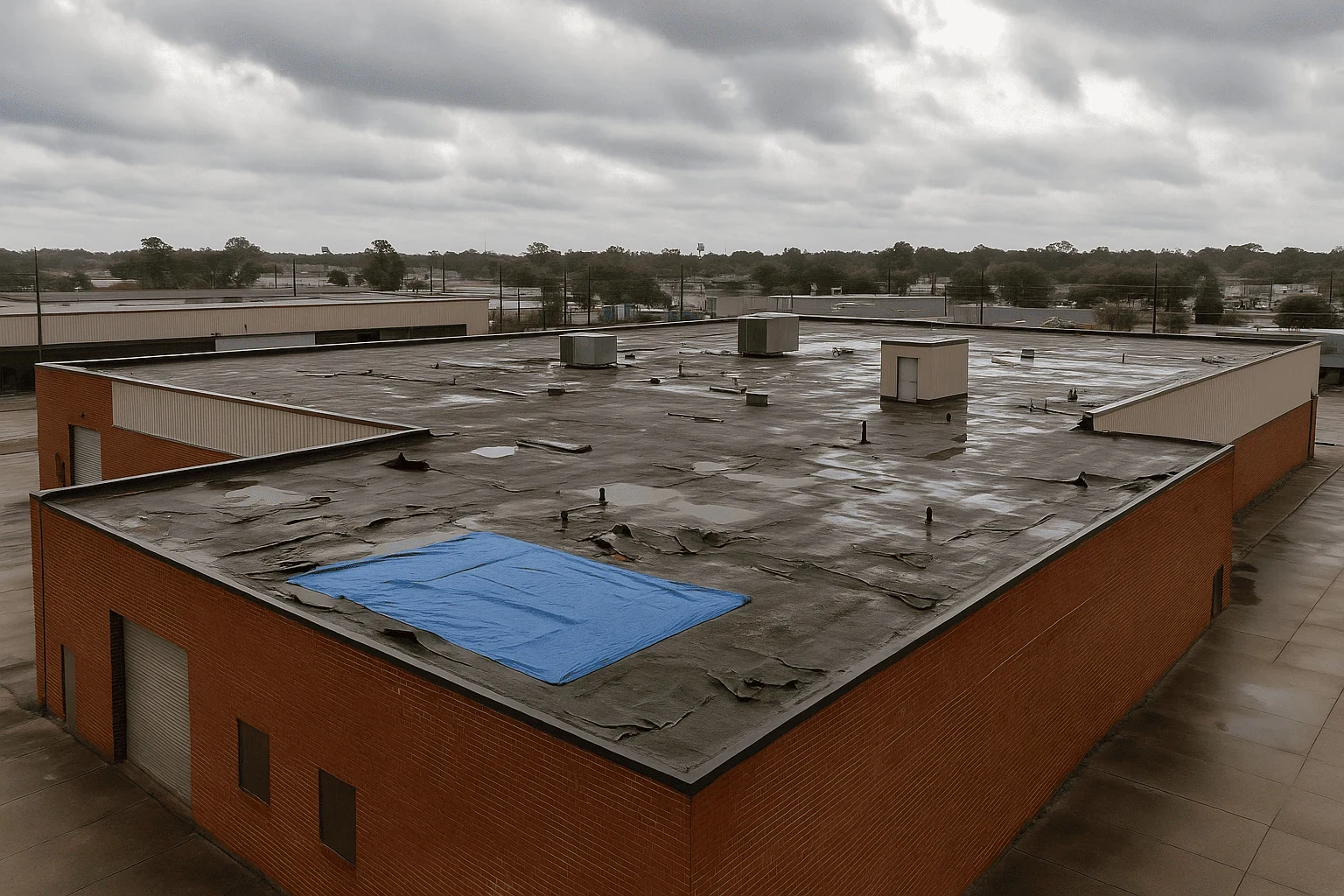
A post-storm assessment starts with dated, location-tagged photos of every finding — lifted edge metal, membrane tears, saturated insulation areas identified through moisture scanning, ponding that has persisted beyond what is normal for the roof. We separate what appears to be storm-caused from pre-existing wear as clearly as the physical evidence allows, since that distinction is often central to how a claim gets evaluated.
Where damage is not visually obvious — saturated insulation under an intact membrane, for instance — we run a moisture scan specifically so the record includes what is actually happening below the surface, beyond what is visible from a roof walk.
For buildings with more than one storm event in their history — not uncommon here given how often this region sees a named storm's remnants in a given decade — we keep each event's documentation separate and dated, rather than one running file that blurs which damage came from which storm.
Working Alongside Adjusters and Public Adjusters
We will walk a roof with an insurance adjuster or a public adjuster if that is useful to the owner's process, answering direct technical questions about what we found and why. We stay in our lane during that conversation — describing roof condition and repair scope, not arguing coverage interpretation, which is between the owner, their policy, and their carrier.
If a scope of repair gets disputed, we can provide additional detail or re-inspect specific areas in question, but we do not adjust our documentation to support a particular claim outcome either direction. The record reflects what is actually on the roof.
What a Documentation Package Includes
A storm damage documentation package typically covers:
- Dated, photo-documented findings tied to specific roof locations
- Moisture scan results for suspected saturated insulation
- Pre-existing condition comparison where a prior inspection report exists
- Separation of storm-related damage from pre-existing wear where evidence allows
- Written repair scope and estimated cost for the documented damage
Documentation Questions Owners Ask During Claims
Can you tell my insurance company the roof damage was caused by the storm?
We document what we observe — the type of damage, its likely cause based on physical evidence, and how it compares to any prior condition record. We are not in a position to guarantee how a carrier will classify that damage, but we give them and you real information to work from.
Do I need a pre-storm inspection report for a claim to work?
It is not required, but it makes a real difference. Without one, the claim relies more heavily on post-storm assessment alone to establish what changed, which is a harder case to make than showing a clear before-and-after.
Will you handle the whole claims process for us?
No — we handle the roof documentation and repair scope. Filing, negotiating, and settling the claim itself is between the owner, their insurer, and their public adjuster if they have hired one.
How fast can you get documentation together after a storm?
We prioritize active damage assessment right after a storm event, generally within days depending on call volume across the region after a widespread event. The sooner the documentation happens, the more the record reflects the storm's actual effect rather than weeks of additional weather.
What if the insurance company disputes what you found?
We are available to answer additional questions or re-inspect specific areas if a carrier's adjuster wants clarification. Our documentation does not change to fit a particular outcome — it is a factual record either way.
For the fuller claim-assistance overview — from the first roof walk through a disputed reinspection — see our commercial roof insurance claim assistance page. If the damage traces to a specific storm, our wind and storm damage and hail damage pages cover what each looks like on a low-slope roof.