
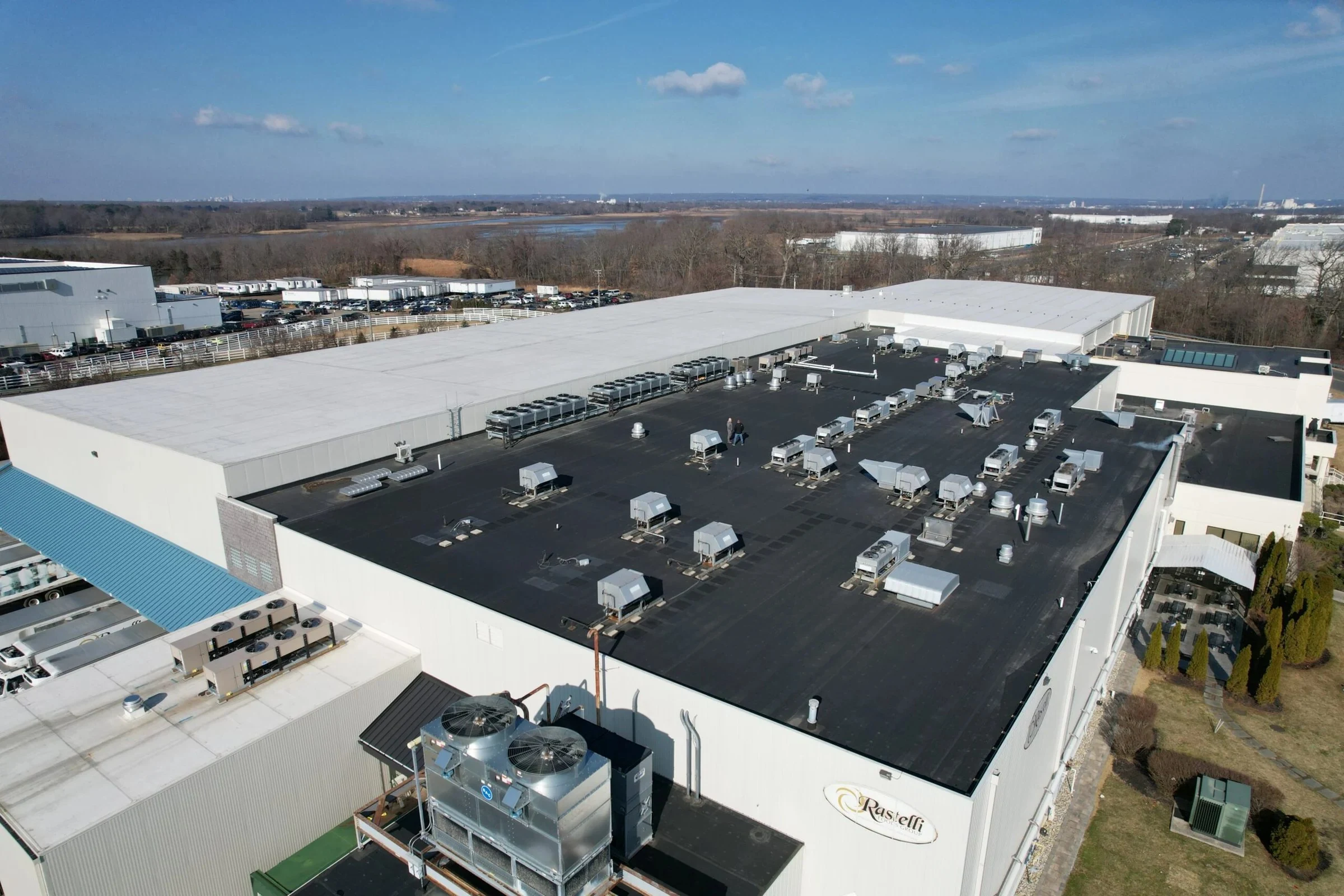
Manufacturing Plant Roofing in Fayetteville, NC
Roofing for manufacturing and food processing plants in Sanford, Clinton, Raeford, and Tar Heel, sized to what each plant vents onto its own roof.
Manufacturing Plant Roofing in Fayetteville, NC
Roofing for manufacturing and food processing plants in Sanford, Clinton, Raeford, and Tar Heel, sized to what each plant vents onto its own roof.
Roofing Over Plants That Don't Stop Running
Between the Pfizer and Caterpillar plants in Sanford, Prestage Foods in Clinton, House of Raeford in Raeford, and the Smithfield plant in Tar Heel, this region runs a lot of manufacturing and processing square footage that operates on shifts around the clock. A roof project over an active plant has to work around production, not the other way around.
What's Coming Off the Roof Matters as Much as What's On It
A food processing plant's roof takes a beating from underneath as much as from weather above. Steam, grease-laden exhaust, and washdown moisture all vent upward and attack a membrane differently than clean office air does. Prestage and House of Raeford's poultry operations and the Smithfield plant's pork processing all generate that kind of rooftop exposure, and it changes which membrane and coating actually hold up long term.
Pharmaceutical and heavy equipment manufacturing, like the Pfizer and Caterpillar operations in Sanford, bring a different set of demands: larger and heavier rooftop equipment, tighter HVAC tolerances, and stricter documentation requirements tied to the plant's own quality and safety systems.
We evaluate the process exhaust and mechanical load on a plant roof before recommending a membrane, because a spec that works fine on a warehouse next door can fail early over a plant discharging steam and grease into the same rooftop environment.
Cotton and grain-adjacent agricultural processing further out toward Sampson and Bladen counties adds its own version of this problem: dust and particulate settling on a membrane changes how it ages and how often it needs to be cleaned and inspected, a maintenance need that's easy to underestimate compared to the more obvious steam and grease exposure at a poultry or pork plant.
Scheduling Around Shift Work and Production Lines
Plants running three shifts don't have an empty building at any point in the week, which means roof work happens over active production, not before or after it. We coordinate directly with plant maintenance and safety teams on which zones are safe to stage over during which shift, and we treat that coordination as part of the job, not an inconvenience to route around.
Plants that run a fixed maintenance shutdown window once or twice a year, rather than a continuous three-shift schedule, give us a cleaner opportunity to do larger recover or replacement work, and we ask a plant's maintenance team early whether that kind of window exists before assuming every project has to happen over live production.
Emergency response is different here too. A roof leak over a production line at a food processing plant can trigger a line shutdown for contamination control reasons that have nothing to do with the roof leak itself, so speed on our end has downstream consequences that go well past the roof.
Rooftop Equipment and Access on an Industrial Building
Manufacturing roofs tend to carry more rooftop equipment than a typical commercial building: exhaust fans, makeup air units, dust collection, process piping, often added over years by different contractors with different levels of care around flashing and penetration sealing.
Heavy equipment manufacturing plants like the Caterpillar operation in Sanford also route overhead crane rail supports and structural steel close to the roof deck in some bays, which changes clearance and access planning for anything we do near those zones compared to a standard open-span warehouse roof.
We inventory rooftop penetrations and equipment supports as part of an initial inspection, because a leak on a plant roof this dense with equipment is more often a failed penetration seal than a failed membrane field.
- Food processing steam and grease-laden exhaust exposure
- Washdown moisture and drainage capacity
- Tighter-tolerance HVAC rooftop loads
- Heavy equipment rooftop support and access
- Dense penetration and flashing inventories on older plant roofs
- Shift-based scheduling for maintenance and repair access
Documentation for Plant Safety and Quality Systems
Manufacturing facilities, especially food processing and pharmaceutical operations, run internal audits that touch the roof: sanitation programs, safety walkthroughs, insurance inspections. We provide maintenance logs and repair records in a format that plugs into those existing audit systems instead of creating a separate paper trail plant staff have to reconcile.
For storm-related roof damage on a plant, we document conditions factually for whatever insurance or internal reporting process applies, without promising a specific claim result.
We also note which rooftop repairs involved hot work, since a plant's own safety program often tracks hot work permits separately from general maintenance records, and having that distinction already documented saves a plant safety officer from having to reconstruct it after the fact.
Questions From Plant Managers and Facilities Engineers
Can you schedule roof work around a plant that never fully shuts down?
Yes. We coordinate with plant maintenance and safety leads on shift-by-shift access and stage work in zones that don't interfere with active production lines.
Do food processing plants need a different roof membrane than a typical warehouse?
Often, yes. Steam, grease, and washdown moisture venting from below change how a membrane and coating perform over time, so we evaluate what the plant discharges before recommending a system.
How fast can you respond to a roof leak over an active production line?
We treat production-line leaks as priority emergency response, since a leak over food or pharmaceutical processing can trigger a contamination-driven line shutdown independent of the roof issue itself.
Do you inspect existing rooftop equipment penetrations, or just the membrane?
Both. On plant roofs with a lot of rooftop equipment, a failed penetration seal is a more common leak source than a failed membrane, so we inventory penetrations as part of any inspection.
Can you provide documentation that fits into our internal safety or sanitation audit process?
Yes. We format maintenance logs and repair records to plug into an existing audit system rather than creating a separate record plant staff have to cross-reference.